Stair lift types
Straight Stair Lifts
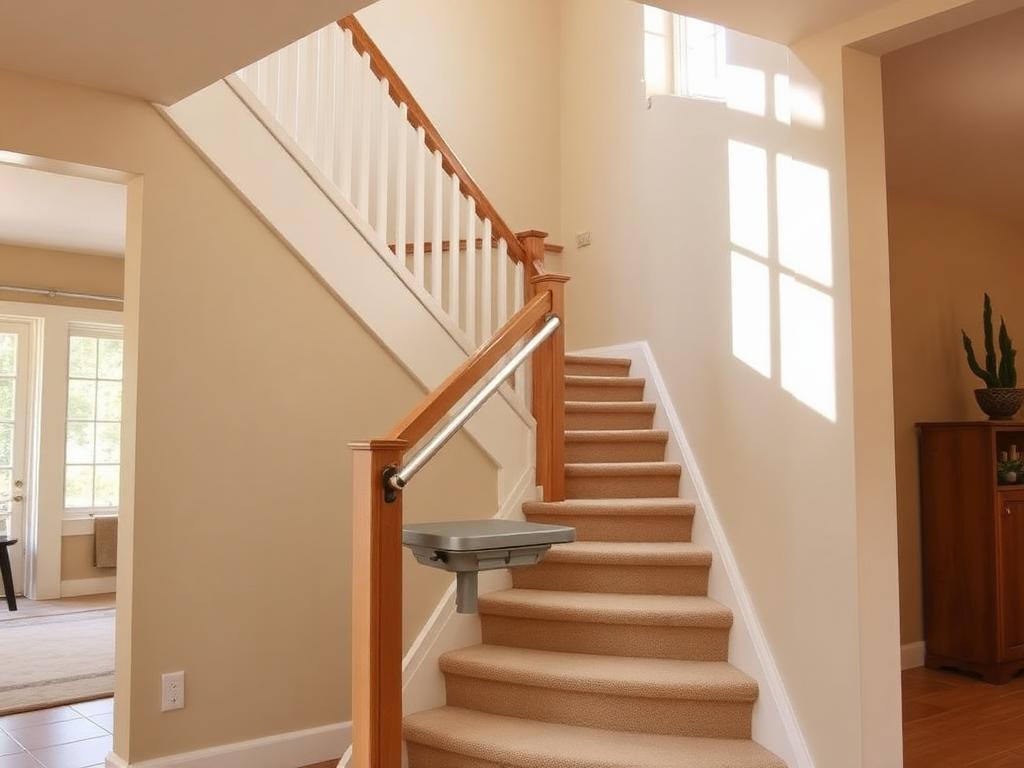
A straight stair lift runs on a single rail fixed to the stair treads of a staircase that has no turns, bends or intermediate landings. Because the rail is a standard section cut to length, a straight lift is normally the simplest and quickest stair lift to measure and install.
Best suited to
- One continuous flight from the bottom step to the top step
- No landing, turn or curve part-way up
- A staircase wide enough that a folded lift still leaves a walking path
- A standard household power outlet available near the top or bottom of the stairs
How a straight stair lift is put together
Three parts do the work: a rail, a carriage that travels along it, and a seat with a footrest and armrests. The rail is fastened to the stair treads — the horizontal surfaces you walk on — not to the wall. That matters for two reasons: the load is carried by the staircase structure rather than by drywall, and the mounting is the same whether the staircase has a wall on one side, two sides or none.
The seat, footrest and arms fold up when the lift is parked, so the staircase stays usable by everyone else in the household. How much clear width remains after folding depends on your staircase, and we measure it during the assessment rather than estimating it in advance.
How to tell whether your staircase is straight
Stand at the bottom and look up. If you can see the top step from the bottom step without the stairs bending, turning or pausing at a landing, the staircase is straight. If there is even a small quarter-turn — three or four wedge-shaped steps at the top or bottom — it is a curved staircase and usually needs a curved rail.
A staircase that turns is not a problem; it simply changes which product fits. If you are not sure what you have, take a photo from the bottom of the stairs and bring it to the assessment.
What installation day involves
Installation is done in your home by our team. The rail sections are set out, fixed to the treads, and the carriage and seat are fitted and tested on the actual staircase. No structural changes to the house are made, and the staircase is not rebuilt.
Before we leave, we walk through operating the lift with the person who will use it every day, and with anyone else in the household who may need to send the lift up or down. That includes the seat controls, the remote controls at each end of the stairs, the safety sensors and the manual release.
Questions we answer during the assessment
- The measured length of your staircase and the rail length that follows from it
- Which side of the staircase the rail should sit on
- Where the seat should park at the top and bottom so it does not block a doorway
- How the lift is powered and what happens during a power outage on the specific equipment recommended
- Weight capacity, seat width and any options for the person who will use it
- Total written cost, before you decide anything
Common questions
- Will a straight stair lift damage my stairs?
- The rail is bolted to the stair treads, which leaves fixing points in the treads rather than in the wall. Whether those points are visible after removal, and how they are finished, depends on your stair surface — we look at that with you before installation.
- Can other people still use the staircase?
- The seat, arms and footrest fold up when the lift is parked. The clear width left over depends on how wide your staircase is, which we measure during the assessment.
- How long does a straight installation take?
- A straight rail is cut from standard sections, so it is normally the fastest type to install. We give you a timeframe for your specific staircase after measuring, rather than a general figure.
Keep reading
- Curved stair liftsIf your staircase turns, bends or has a landing.
- Straight vs. curved stair liftsA side-by-side comparison of the two rail types.
- Harmar Pinnacle SL600HDAn informational guide to this 600 lb indoor straight model.
- Book an appointmentCall Rick to discuss your staircase and request a visit; every time requires approval.
Get started
Book an appointment
Request an in-home stair lift assessment. Your visit time is confirmed only after Rick or the team approves it.
Loading calendar…
Take the First Step Toward a Safer Home
Request an in-home assessment. Rick measures your staircase and explains which lift fits — free within the qualifying 40-mile service radius.