Stair lift types
Curved Stair Lifts
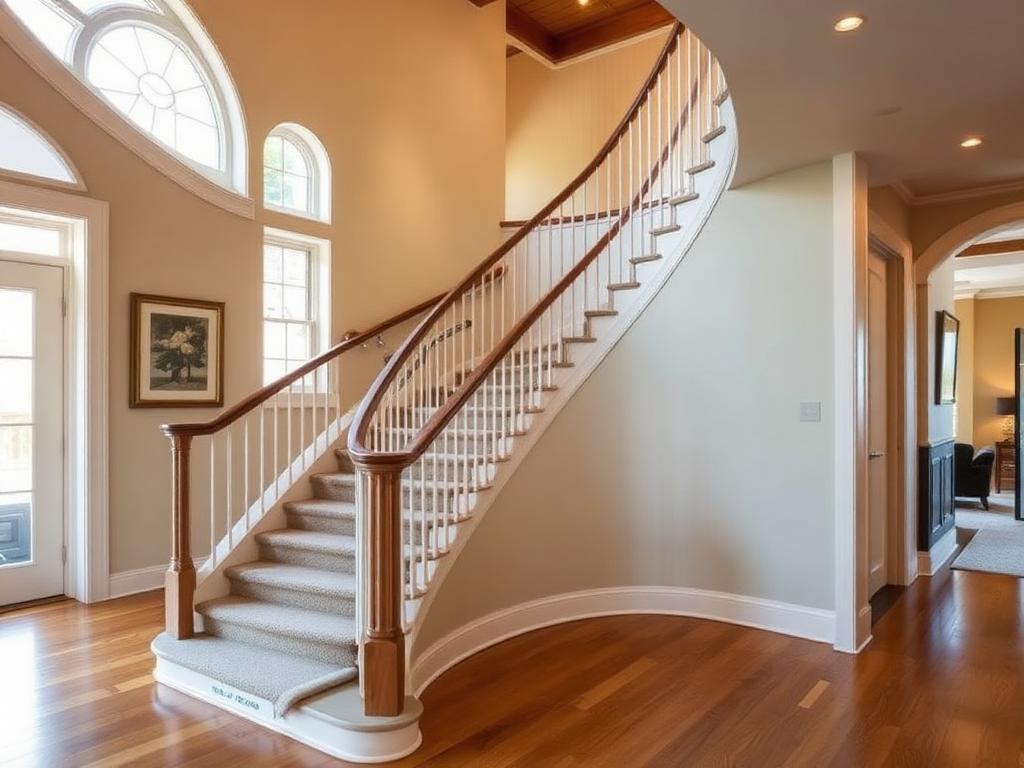
A curved stair lift is used when a staircase turns, bends, or pauses at a landing. The rail cannot be cut from a standard length — it is measured and manufactured for your individual staircase, which means a longer lead time than a straight lift and a more detailed measuring visit.
Best suited to
- Staircases with a 90-degree or 180-degree turn
- Staircases with an intermediate landing between flights
- Spiral or helical staircases
- Straight flights that need the seat to park clear of a doorway at the top or bottom
Why a curved staircase needs a custom rail
On a straight staircase, one angle repeats the whole way up. On a curved staircase, the angle changes continuously as the rail turns, and it changes again where the pitch flattens across a landing. A rail that follows those changes has to be bent to the precise geometry of your stairs so that the seat stays level and the carriage keeps constant contact with the drive.
That is why curved lifts are measured with far more detail than straight ones, and why the rail is manufactured after the measuring visit rather than carried on the van.
What the measuring visit involves
We record the rise and run of every flight, the shape and radius of each turn, the depth of the landing, the position of doorways, radiators, newel posts and handrails, and the finished floor level at the top and bottom. Photographs are usually taken as well, so the measurements can be checked against the real staircase.
The result is a rail drawing specific to your home. Nothing is ordered until the layout, the parking positions at each end and the total written cost have been reviewed with you.
Landings, turns and where the seat parks
One of the practical advantages of a curved rail is that it can continue past the top step and around a turn, so the seat parks out of the walkway instead of directly in front of a bedroom door. The same applies at the bottom, where a rail can curve away from an entry so the hallway stays clear.
Whether that is possible in your home depends on the space at each end of the staircase. It is one of the things we look at during the assessment, because it usually makes more day-to-day difference than any other option.
Planning ahead for a curved lift
- Expect two stages: a measuring visit, then installation once the rail is built
- Lead time depends on the rail design and the manufacturer's schedule; we give you the timeframe in writing after measuring
- If the need is urgent, tell us at the assessment so we can discuss what is realistic
- Nothing is manufactured, and nothing is charged, before you approve the design and cost
Common questions
- Can a stair lift go around a corner?
- Yes. A curved rail is built to follow the turn, so the lift travels from the bottom step to the top step in one journey without the user transferring between two separate lifts.
- Why does a curved stair lift take longer than a straight one?
- The rail is manufactured to the measurements of your specific staircase, so there is a measuring visit first and installation happens once the rail has been built.
- Does a spiral staircase rule out a stair lift?
- Not automatically. Spiral and helical staircases are handled with a curved rail, but the tightness of the turn and the width of the treads decide what is possible. That has to be measured in person.
Keep reading
- Straight stair liftsFor a single flight with no turns or landings.
- Straight vs. curved stair liftsHow the two rail types differ in measuring, timing and cost drivers.
- AmeriGlide InfinityAn informational guide to a made-to-measure curved model.
- FinancingHow payment options are discussed during the assessment.
Get started
Book an appointment
Request an in-home stair lift assessment. Your visit time is confirmed only after Rick or the team approves it.
Loading calendar…
Take the First Step Toward a Safer Home
Request an in-home assessment. Rick measures your staircase and explains which lift fits — free within the qualifying 40-mile service radius.